For feature details, visit Whova
ABOUT THE SPEAKER:
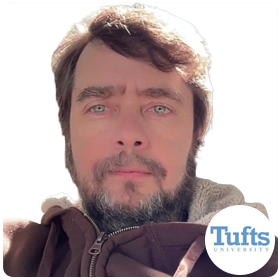
Michael Levin is the Vannevar Bush Distinguished Professor of Biology at Tufts University, and associate faculty at Harvard’s Wyss Institute. He serves as the director of the Allen Discovery Center at Tufts and the co-director of the Institute for Computationally Designed Organisms at Tufts/UVM. He has published over 400 peer-reviewed publications across developmental biology, computer science, and philosophy of mind. Dr. Levin received dual B.S. degrees in computer science and biology, followed by a Ph.D. from Harvard with Clifford Tabin. His graduate work on the molecular basis of left-right asymmetry (Cell 1995) was chosen by the journal Nature as a “Milestone in Developmental Biology in the last century”. He did post-doctoral training at Harvard School of Medicine in cell biology, and started his independent lab in 2000, developing the first molecular tools to read and write bioelectric prepatterns in non-neural tissue. His group at Tufts works to understand information processing and problem-solving across scales, in a range of naturally evolved, synthetically engineered, and hybrid living systems. The Levin lab has pioneered approaches to organ regeneration, cancer reprogramming, non-genetic modification of the bodyplan, and the engineering of novel living proto-organisms. Using tools from behavioral and computer science, Dr. Levin seeks to understand the collective intelligence of cells and harness their problem-solving capacities for applications in birth defects, regeneration, cancer, and synthetic bioengineering.
TALK TITLE:
TRACK:
SUB TOPIC:
ABSTRACT:
In this talk, I will describe our progress in the emerging field of Diverse Intelligence: efforts to understand the origin, scaling, and metamorphosis of minds. I will begin by describing the multiscale competency architecture of life, which arises from the need to evolve on a fundamentally unreliable material. Our journey from a single cell reveals a spectrum of intelligence in exotic problem spaces, far older and more general than brains and neurons. My group is working on tools and conceptual frameworks enabling us to recognize, ethically relate to, and facilitate the existence of novel forms of mind. Using morphogenesis as a model system for communicating with unconventional collective intelligences, I will show how deep philosophical ideas on the scaling of the cognitive light cone translate into practical applications in regenerative medicine and cancer. Then, moving beyond natural life forms, I will show our novel living beings. Their existence and capabilities raise fundamental questions about the competencies, preferences, and cognitive properties of novel beings which were neither designed by engineers nor evolved. Where do kinds of minds come from? I will conclude with a new model on a Platonic space of agential patterns, and the implications for AI, as well as for the plethora of chimeric and hybrid beings with whom we will share our world.
WHAT YOU’LL LEARN:
Business Leaders: C-Level Executives, Project Managers, and Product Owners will get to explore best practices, methodologies, principles, and practices for achieving ROI.
Engineers, Researchers, Data Practitioners: Will get a better understanding of the challenges, solutions, and ideas being offered via breakouts & workshops on Natural Language Processing, Neural Nets, Reinforcement Learning, Generative Adversarial Networks (GANs), Evolution Strategies, AutoML, and more.
Job Seekers: Will have the opportunity to network virtually and meet over 30+ Top Al Companies.
Ignite what is an Ignite Talk?
Ignite is an innovative and fast-paced style used to deliver a concise presentation.
During an Ignite Talk, presenters discuss their research using 20 image-centric slides which automatically advance every 15 seconds.
The result is a fun and engaging five-minute presentation.
You can see all our speakers and full agenda here