For feature details, visit Whova
ABOUT THE SPEAKER:
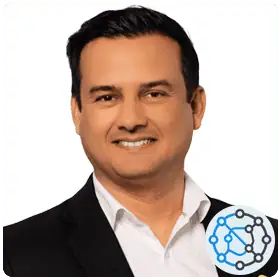
Himanshu Joshi is the Founder and CEO of COHUMAIN Labs, where he leads initiatives on collective intelligence between humans and machines. He spearheaded the development of SAFEALIGN AI, a platform focused on the safe, secure, and aligned deployment of agentic AI in enterprises. Previously, he served as a Team Lead for the AI Projects at the Vector Institute for Artificial Intelligence, driving responsible AI initiatives that generated over $170 million in documented enterprise value across Fortune 500 organizations.
An internationally recognized thought leader in agentic AI, governance, and AI security, Himanshu has authored books and LinkedIn Learning courses on AI adoption and published 15+ peer-reviewed papers at leading venues including NeurIPS, ICLR, IEEE, AAAI, and ICDM. He serves as Program Chair for the AAAI 2026 AI Governance Workshop and contributes as a track lead and reviewer across major global AI conferences. He is also the recipient of the AI Ally of the Year 2025 (North America): Special Jury Award.
He completed the EPGM at the MIT Sloan School of Management and is pursuing doctoral research on human-AI collective intelligence, alongside an M.S. in Artificial Intelligence at the University of Texas at Austin. He also holds double M.S. degrees in Technology and Strategy.
TALK TITLE:
TRACK:
SUB TOPIC:
ABSTRACT:
Enterprise deployment of autonomous multi-agent systems (MAS) has surged, yet existing governance frameworks designed for traditional software or single-agent systems prove inadequate for managing emergent behaviors, coordination vulnerabilities, and distributed agency. We introduce \textbf{meta-governance}, by means of SafeAlign AI Governance and Responsible AI OS via the use of specialized intelligent agents to monitor and control operational agent fleets, as a scalable paradigm for achieving comprehensive Safety, Alignment, Governance, and Security (SAGS) in production MAS deployments. Through analysis of regulatory requirements (EU AI Act, NIST AI RMF, Singapore Framework), documented failure modes, and novel attack vectors, including inter-agent trust exploitation, we establish design principles for production-grade MAS governance systems. We validate these principles through deployment scenarios in regulated industries (financial services, healthcare, and pharmaceuticals), managing 100+ operational agents, demonstrating that meta-governance can achieve sub-second intervention latency, 100 % safety-critical policy compliance, and automated decision handling while maintaining comprehensive audit trails. Our framework addresses the fundamental asymmetry between attack propagation speed and human oversight capacity, enabling enterprises to deploy autonomous agents at scale with regulatory compliance and risk mitigation.
WHAT YOU’LL LEARN:
Business Leaders: C-Level Executives, Project Managers, and Product Owners will get to explore best practices, methodologies, principles, and practices for achieving ROI.
Engineers, Researchers, Data Practitioners: Will get a better understanding of the challenges, solutions, and ideas being offered via breakouts & workshops on Natural Language Processing, Neural Nets, Reinforcement Learning, Generative Adversarial Networks (GANs), Evolution Strategies, AutoML, and more.
Job Seekers: Will have the opportunity to network virtually and meet over 30+ Top Al Companies.
Ignite what is an Ignite Talk?
Ignite is an innovative and fast-paced style used to deliver a concise presentation.
During an Ignite Talk, presenters discuss their research using 20 image-centric slides which automatically advance every 15 seconds.
The result is a fun and engaging five-minute presentation.
You can see all our speakers and full agenda here