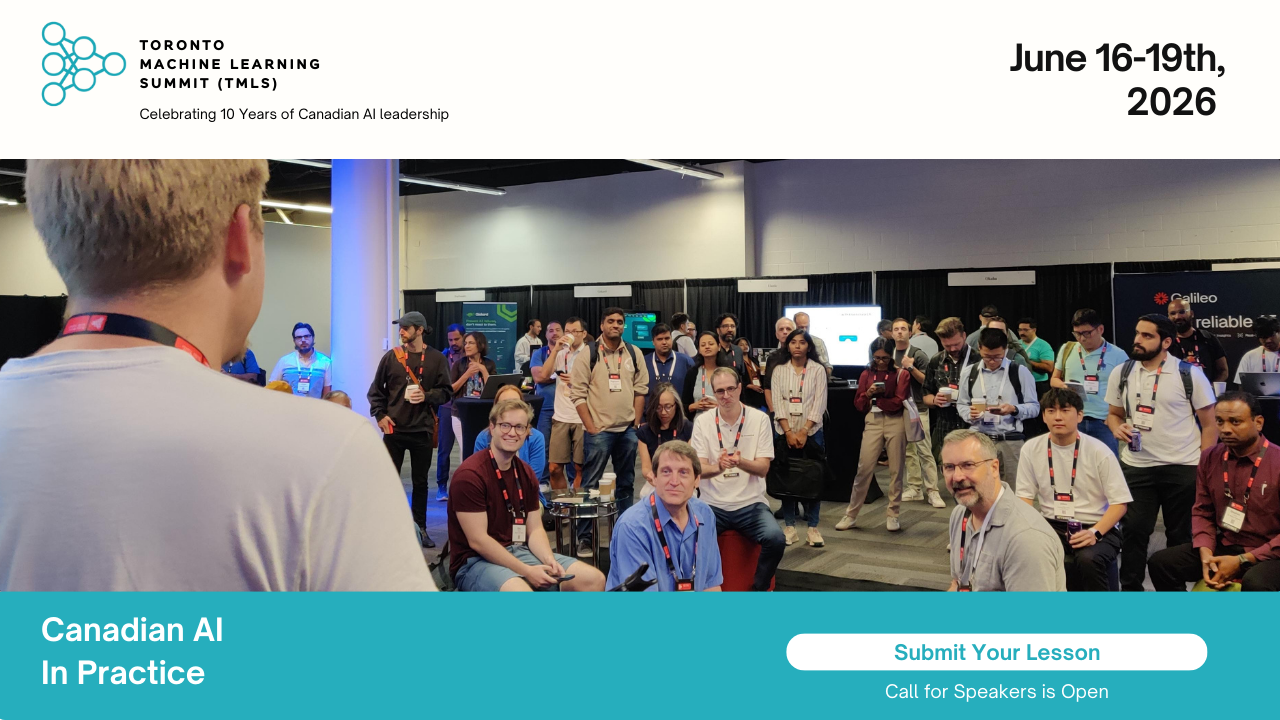

This year is the 10th Toronto Machine Learning Summit (TMLS).
For a decade, TMLS has been shaped by people who have to own ML outcomes in the real world, in Canada, under the constraints we actually operate in: regulation, procurement cycles, legacy environments, and risk.
TMLS exists to give Canadian practitioners, researchers, and leaders a credible place to talk about what really happened when systems were built, deployed, governed, and lived with, so the community learns from durable experience, not polished stories.
→ See TMLS 2026 details and register
TMLS 2026: dates and format
- Virtual talks: June 16, 2026
- In-person conference: June 17–18, 2026
- Workshops: June 19, 2026
- Location: Toronto, Canada
Why 10 years matters
Anyone can run a flashy event once. What’s harder is building a room people return to, because the conversations are honest, specific, and useful.
TMLS has held up because:
the community has continuity, people bring last year’s lessons into this year’s debates
the program is shaped by practitioners who care about reality, not optics
the Canadian context is treated as the point, not a footnote
Who TMLS is for
TMLS isn’t aimed at beginners or hobbyists. It’s built for people who are responsible for outcomes:
- Research leads deciding what’s worth building (and what isn’t)
- ML engineers / applied ML leads building systems that have to survive real environments
- Platform / infra owners supporting long-lived ML stacks
- Data science managers + product leaders accountable for deployed AI decisions
- Executives overseeing AI in regulated or complex organizations
If you’re operating in Canada, or in similarly constrained environments, this room will feel familiar.
Who TMLS is for
The committee repeatedly surfaced a blunt truth from operators:
When the risk is ambiguous, there’s a significant challenge to get sign-off.
Common blockers included:
- Liability ambiguity for probabilistic behavior (“What happens when it’s wrong?”)
- PII exposure and privacy risk in real workflows
- Data leakage concerns
- Prompt injection and related adversarial behaviors in systems that accept user input
What’s important here: the dominant constraint wasn’t tooling. It was the absence of shared internal frameworks for assessing and governing probabilistic systems in regulated environments.
In other words, even if a team can build it, the organization often can’t legitimately approve it yet.
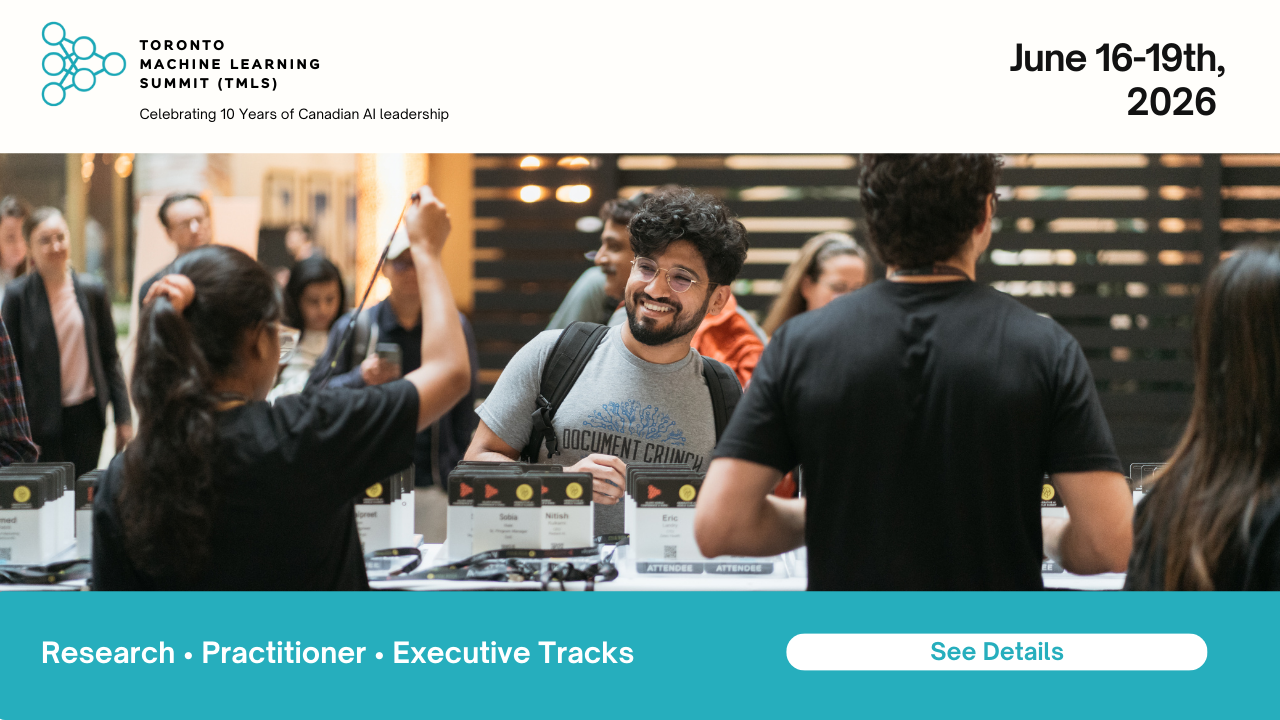
Three tracks, one shared goal: better decisions under real constraints
TMLS is intentionally cross-role, because the hardest problems show up between teams, where research choices meet system constraints and organizational reality.
Research Track
For research leads and applied researchers pressure-testing what’s real, what’s feasible, and what survives contact with real-world constraints.
Practitioner Track
For the builders: applied ML, engineering, and platform teams working through tradeoffs, legacy realities, monitoring, and long-lived system decisions.
Executive Track
For leaders accountable for risk, governance, budgets, policy, and outcomes, especially when ML decisions collide with regulation, procurement, and organizational constraints.
Registration is live (including Early Bird options)
If you want to join the 10th year of TMLS, registration is live (including Early Bird options).